
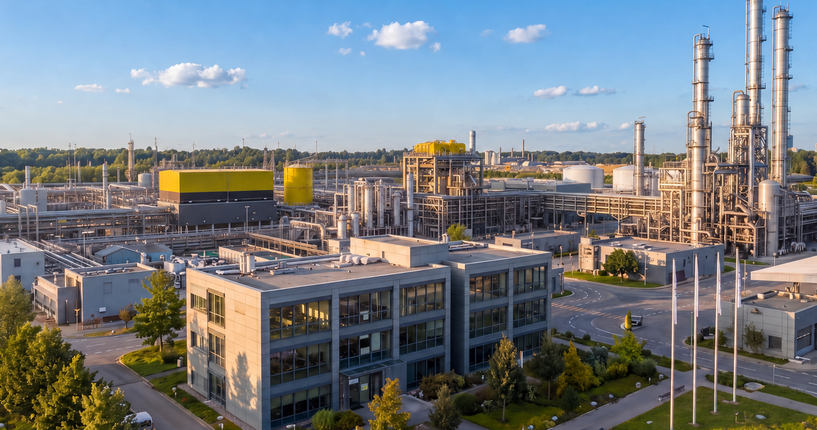
According to a statement, solar fuel company Synhelion has launched plans for a large-scale plant for the production of renewable synthetic fuels, so called e-fuels. The facility is set to produce 30,000 tons of fuel per annum. This will primarily be sustainable aviation fuel, although synthetic diesel and gasoline for the shipping and road transport sectors will also be produced. The facility is planned for the RWE site in Hürth-Knapsack in the German federal state of North Rhine-Westphalia.
This project adds to Synhelion’s portfolio of commercial fuel facilities, which also includes the planned expansion of the demonstration plant DAWN at Forschungszentrum Jülich, a research hub located in Germany. However, construction of the planned first commercial plant in Spain was shelved in the summer of 2025 due to planning uncertainties.
Founded in 2016 as a spin-off from the Swiss Federal Institute of Technology in Zurich, Synhelion explains further that it has commissioned the Milan-based oil and gas group Saipem to carry out what is known as Pre-FEED (Front-End Engineering Design) work for this commercial plant. According to Synhelion, the project combines the company’s proprietary fuel technology with Saipem’s technical expertise and RWE’s industrial infrastructure and site-specific capabilities. To this end, Synhelion has reserved a site owned by RWE at Knapsacker Hügel in Hürth.
The chemical site located there, usually referred to as the Chemiepark Knapsack, is increasingly being transformed in the direction of circular economy and climate protection applications. Due to the fact that existing pipelines and supply systems can be utilized, Synhelion states that the established industrial site offers favorable conditions for rapid and cost-efficient project development. In addition, RWE is reportedly providing support in relation to site development and permit processes.
“Scaling our technology is key to making renewable fuels commercially competitive”, comments Philipp Furler, co-CEO of Synhelion. “Our joint pre-FEED work is an essential step in that direction, establishing a robust engineering basis for one of our commercial-scale plants. Saipem and RWE are strong partners for this scale-up phase.” ce/mm