
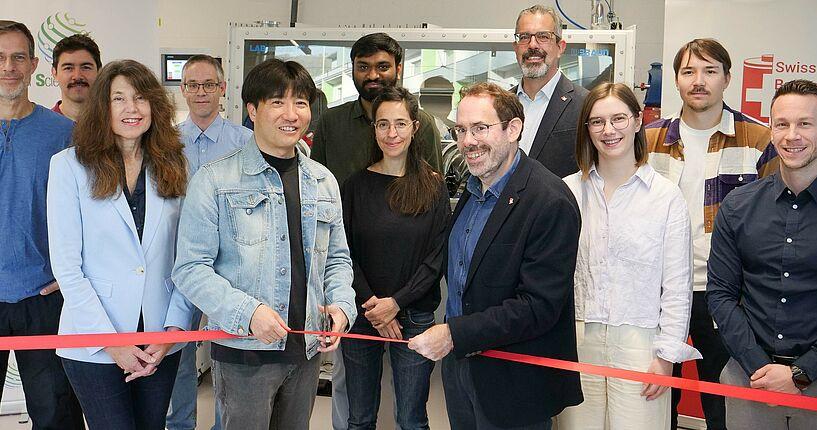
Headquartered in the Japanese city of Kawanishi on the northern fringes of Osaka, Green Science Alliance (GSA) is joining forces with the Swiss Battery Technology Center (SBTC) and will receive support at its newly opened laboratory at Switzerland Innovation Park Biel/Bienne, as detailed in a joint statement issued by GSA and SBTC. GSA has developed an approach that allows lithium-ion batteries to be reused without needing to first be broken down into their individual components. This application is being implemented in the new laboratory, while the SBTC, as one of the four applied research centers based at SIPBB, is supporting the Japanese company by providing scientific expertise and the infrastructure required for further development and testing.
GSA’s approach is based on something known as “black mass”, which is a substance generated during the recycling of used lithium-ion batteries. It contains materials that can be used to store and release energy. In conventional methods, these materials are extracted from the black mass using acids or bases before being further processed in order to make them usable. In contrast, GSA aims to regenerate these materials directly from the black mass to be used in new batteries, which it hopes could reduce the number of process steps required and lead to a more sparing consumption of resources.
GSA is now keen to scale its lab-based approach for industrial applications and expand in the European battery industry. GSA decided to base its operations for these expansion plans in Biel/Bienne. ce/jh