
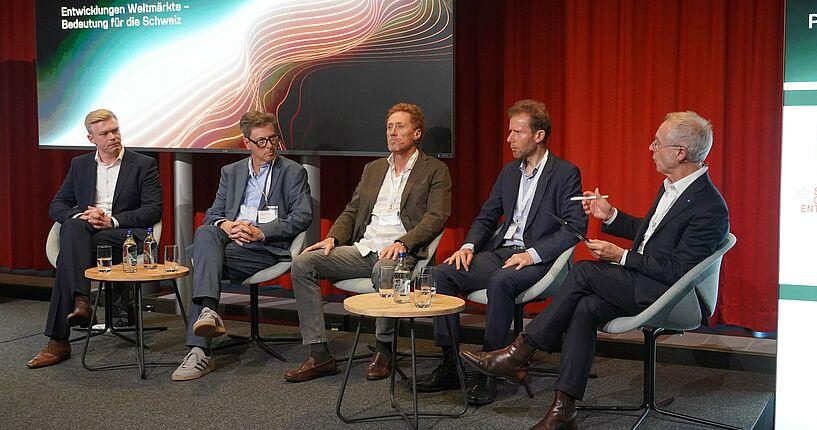
In Switzerland, securing certifications for sustainably produced synthetic fuels is cheaper than paying penalties on imported internal combustion engine cars. This point was raised by Lukas Hoffmann, Senior Consultant at Porsche Consulting in Stuttgart, during the Power-to-X Congress Switzerland in Bern on September 24.
Held at the Kursaal Bern, the event was organized by the Swiss Power-to-X Collaborative Innovation Network (SPIN) and energie-cluster.ch in collaboration with Réseau H2 Suisse Romande, according to a statement. Around 140 experts came together to discuss chemical energy sources as a vital part of efforts aimed at decarbonizing both the economy and society.
Gianfranco Guidati, Deputy Director of the Energy Science Center at the Swiss Federal Institute of Technology in Zurich, pointed out, for example, that Switzerland could turn both to imports of synthetic fuels and moderate domestic production to achieve this aim. Boris Krey of the Swiss Gas Industry Association discussed the importance of chemical energy sources in relation to seasonal storage, diversification and security of supply. In the view of Markus Friedl, Head of the Institute for Energy Technology IET at OST – Eastern Switzerland University of Applied Sciences, green methanol is particularly well suited to seasonal storage on account of its energy density per mass and volume plus the associated negligible storage costs.
Metafuels, which is based in Adliswil in the canton of Zurich, will soon be putting a demo plant into operation. At the Port of Rotterdam, the company is also planning to open its first commercial plant, which from 2030 should be able to produce 10 tons of aviation fuel from methanol per day. Further down the line, this will be scaled to as much as 100 tons per day.
However, Martin Bäumle, member of the National Council, the lower house of the Swiss parliament, representing Zurich for the Green Liberal Party of Switzerland, identifies potential political roadblocks. “The foundations for de-fossilization are set out in the CO2 Act and the Climate Act”, he comments in the statement, adding that: “What is missing is a lawful implementation at ordinance level that reflects the will of Parliament.”
Peter Metzinger shares this view: “The question is no longer whether Power-to-X works, but whether projects in Switzerland get financed, permitted and built. That is exactly what we worked on today”, the Co-Managing Director of SPIN concludes. ce/ug