
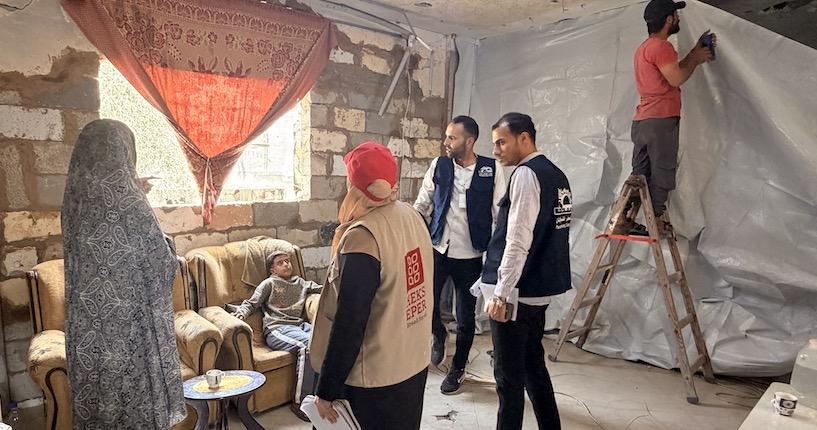
HEKS/EPER, the aid organization of the Protestant Church in Switzerland, has redeveloped the first 22 homes destroyed during the war in Gaza in close collaboration with the Palestinian Housing Council.
Within the framework of a recycling and circular reconstruction concept that was developed and tested during this process, rubble and recyclable building materials from destroyed buildings are being processed and used for repairs. The project is supported by donations and will now be scaled to include more than 100 additional households, with plans to further expand the scope at a later date.
Import restrictions imposed by Israel present a major issue in relation to the construction of new houses and the conventional repair of damaged buildings as they prohibit the transport of materials that can be used for both civilian and military purposes. These include cement, steel and pipes, as well as certain types of equipment.
For this reason, houses damaged by the conflict are being made habitable again as a medium-term accommodation solution through the HEKS/EPER project and its recycling-centric approach. The aim here is to offer vulnerable displaced families in Gaza a greater degree of safety, privacy and quality of life than staying in refugee camps or accommodation lacking in basic structural elements such as exterior walls, windows and fittings.
Specialists work with the families affected to assess and inspect the structural condition of their homes. Based on the residents’ priorities, a detailed repair plan is drawn up, including a list of the required materials and work. This can encompass activities such as repairing exterior and interior walls using clay instead of cement, as well as roof repairs, the restoration of bathrooms and kitchens, and repairs to water tanks.
The household in question is responsible for collecting salvageable and reuseable materials from the old building, for example doors, window frames, steel beams, corrugated metal sheets, piping, bathroom and kitchen sinks, toilets, water tanks and breeze blocks; otherwise, used and new materials must be purchased.
The Palestinian project engineers are on hand to provide support at every stage to ensure that the materials meet the required quality standards, prices are reasonable and the installation is technically safe and acceptable. The respective household is responsible for carrying out the repair work, whether through family members or other contracted professionals. Of course, renovation costs do vary, although they average out at around 3,000 Swiss francs.
HEKS/EPER is one of the exhibitors forming part of the SWISS Pavilion for the Dubai International Humanitarian Aid & Development Conference & Exhibition (DIHAD). The conference for humanitarian aid and development is set to take place August 24-26 in Dubai. The will be the Swiss aid organization’s second appearance at DIHAD, where it will seek to develop partnerships that help to strengthen support for people affected by conflicts, catastrophes and displacement. ce/mm