
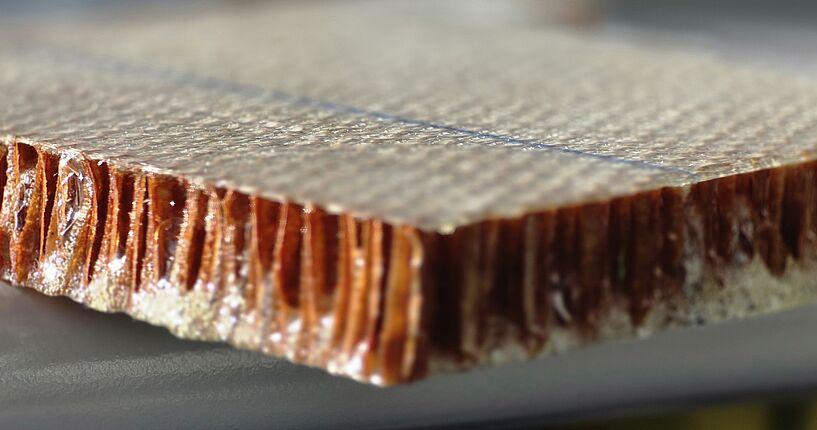
Empa has developed a procedure that makes flame-retardant composites recyclable by using epoxy resin as a binding agent. This was achieved in a project supported by Innosuisse, in which the team from the Empa Advanced Fibers laboratory based in St.Gallen collaborated with Büsserach-based industry partner ELANTAS Europe, part of the German specialty chemicals group Altana.
According to a statement, the focus was on a certain composite that is used for the interior fixtures of aircraft and planes, such as the floors of passenger cabins. In the middle of the sandwich material, there is a honeycomb structure of made from aramid. This heat-resistant plastic is attached to several flat, woven layers of glass or carbon fibers above and below. As with many composites, epoxy resin is the binding agent. Usually, this polymer cannot be recycled. Empa researcher Sabyasachin Gaan commented in the statement: “Composites containing epoxy currently end up in landfills or are incinerated.”
However, the team has now developed an additive for epoxy resin that simultaneously makes it flame-retardant and recyclable. For this, the epoxy is mixed with a phosphorus-containing molecule during production. This means that, with a little heat and the correct solvent, the sandwich can be separated again into its individual components. As these are relatively expensive, their recovery is also interesting from an economic point of view.
With ELANTAS, the researchers are now exploring the material’s potential for an industrial application for the first time. Fiorenzo Lenzi, Head of the Aerospace/Ballistic Product Line at ELANTAS, stated: “For the aerospace industry, it is crucial to combine fire protection, lightweight construction, and recyclability. This epoxy composite system demonstrates that this is now possible for the first time.” Additional applications for the energy and construction sectors are currently being examined. ce/mm