
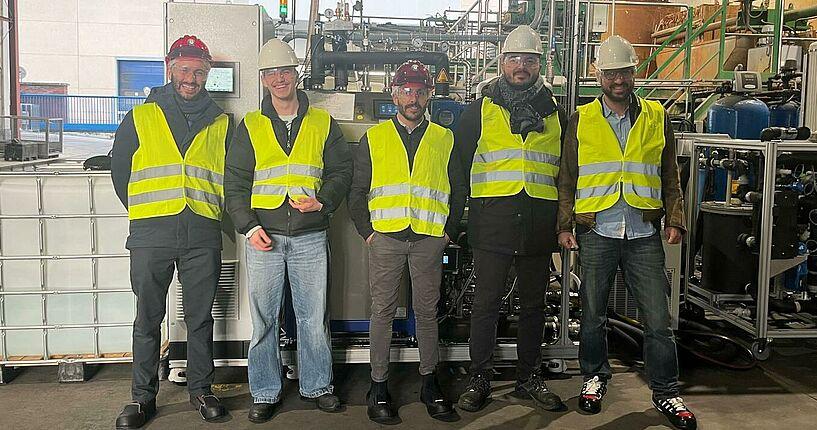
As part of the European research project MEloDIZER, 18 research and development partners are working to reduce water scarcity and the use of harmful chemicals. DeltaMem, based in Allschwil in the canton of Basel-Landschaft, is the sole Swiss partner and plays a key role thanks to its expertise in membrane technology. The project, which runs until spring 2027, aims to develop sustainable approaches for treating wastewater and producing drinking water from saline sources. The experts are pursuing this goal through membrane distillation using innovative high-performance membranes and modules powered by waste heat or solar energy.
“The challenge lies in combining water recovery with the use of alternative energy sources,” says Alessandro Angelini, who is part of the research and development team at DeltaMem. According to Angelini, this aspect is also what gives the new solution its significant potential. By integrating waste heat, the technology can be used not only in arid regions. The new systems are currently being deployed at a chemical company in Spain and at a brewery in Greece. The aim is to reuse industrial wastewater, recover valuable nutrients from aquaculture, and advance decentralized desalination. The pilot plant has already been installed in Spain, comprising a membrane distillation plant from DeltaMem and a heat pump system from the Fraunhofer Institute for Solar Energy Systems ISE in Freiburg, Germany.
The Swiss company has more than 40 years of experience with its PERVAP technology, which is based on so-called pervaporation. Over this period, it has become established worldwide as an energy-efficient industrial technology for the recovery of high-purity solvents, bioethanol and fine chemicals. In MEloDIZER, DeltaMem is adapting this expertise to water treatment and integrating renewable energy sources, creating new conditions for the operation, integration, and scalability. Angelini states: “We have decades of experience in process design and integration, and in transferring applications from the laboratory to industrial-scale production.” This experience puts a strong focus on technical robustness and scalability – qualities that are essential for bringing new solutions into practical use.
DeltaMem’s participation in MEloDIZER not a foregone conclusion. Ultimately it required support from the Swiss government, as Switzerland did not have associate status when the call for proposals was issued. “The support provided by Euresearch was invaluable here,” says the expert, as it served as an interface as the primary Swiss point of contact for matters related to the European Framework Program for Research and Innovation.
According to Angelini, being part of MEloDIZER not only increases DeltaMem’s international visibility but also creates strong synergies through access to international research and industry networks and cutting-edge research. This can open the door to innovative applications and new business areas, while spreading development costs and associated risks across multiple project partners, explains Angelini. And he adds: “EU projects allow technologies to be developed and validated beyond what a single SME could efficiently achieve. ce/yvh