
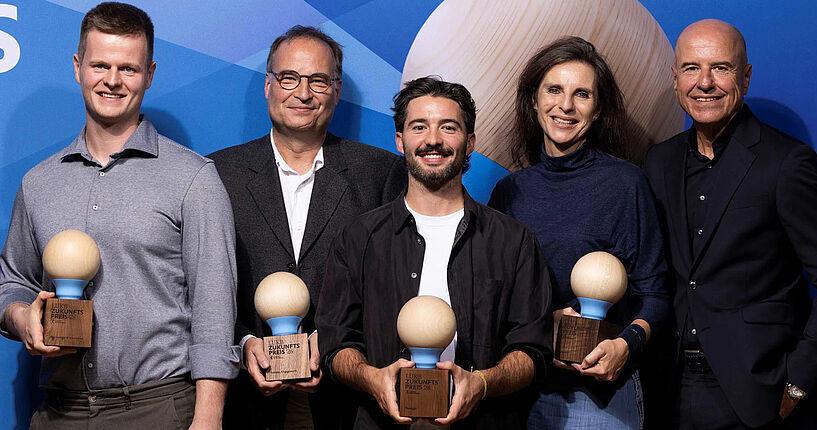
For the fifth time, Luzerner Kantonalbank (LUKB) has recognized sustainable projects in the Lucerne economic region with its Future Award. The top prize winners are Precira, Kiyo, and Dr. Schnodder & Co. The Jury Award 2026, presented for the second time, went to Nettle Circle.
According to a statement, the bank made 150,000 Swiss francs available to support sustainable projects having a positive impact on society and the environment in line with selected United Nations sustainability goals. In 2026, a record number of 91 projects were submitted. In each of the three categories, three projects advanced to the online voting round, which saw 12,000 votes cast – a 50 per cent increase compared to the previous year. The winners received their awards during the annual LUKB Entrepreneurship Day in Emmenbrücke.
The autonomous weeding robot developed by Lucerne-based Precira won in the Technology and Innovation category. Using laser technology, the technology selectively removes and incinerates weeds, helping support the economic viability of organic vegetable farming, according to a statement. The startup, which has a branch at Technopark Lucerne in Root, was founded by Marius Gächter.
Topping the Ecology category is another Lucerne-based startup, Kiyo, with its sensitive toothpaste tabs. These tablets, developed by co-founders Jeffrey Christen and Nando Nichele, are chewable and designed to replace conventional toothpaste. According to LUKB, they can be produced without water, preservatives and additives.
The winning project in the Social Engagement category uses the podcast Dr. Schnodder & Co to share findings on children’s and youth health. LUKB’s description praises the podcast for offering clear, evidence-based guidance. It is produced by the Children’s Hospital of Central Switzerland in collaboration with the Swiss Association of Pediatricians of Central Switzerland.
Nettle Circle received the Jury Award for its nettle fiber processing technique. The startup, based at Technopark Lucerne, was founded by Cornelia Bamert in 2020 and has a registered office in Oberkirch in the Swiss canton of Lucerne. Bamert’s process can extract fiber from the plant irrespective of weather conditions. According to LUKB, it also avoids risks associated with so-called plant roasting, making the entire plant usable. When processed, the fiber is used in textile production as a wool substitute and to work with cotton. The remaining biomass can be processed for agricultural use. ce/yvh