
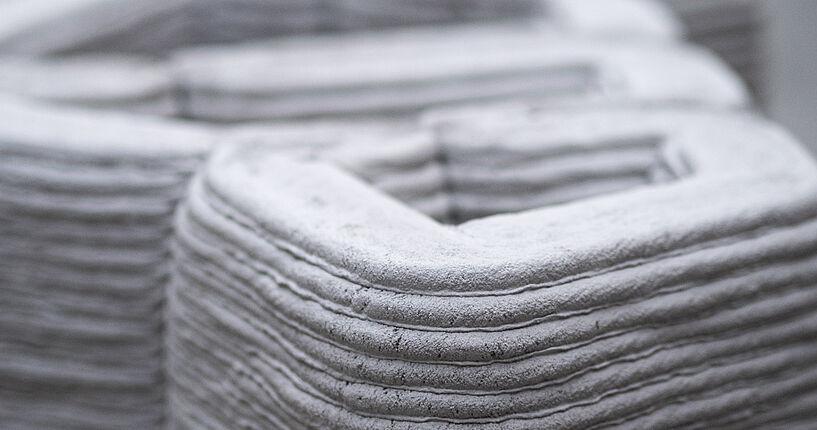
Researchers at the Structural Engineering Laboratory of the Swiss Federal Laboratories for Materials Science and Technology (Empa) in the canton of Zurich are working on the development of concrete components created using a 3D printer. According to a statement, the building components are stable without conventional steel reinforcement and use almost no cement. The material is designed to bind carbon dioxide as it hardens.
The research is being conducted as part of the EU project CARBCOMN (carbon-negative compression dominant structures for decarbonized and de-constructable concrete buildings). In addition to Empa, researchers from the Swiss Federal Institute of Technology Zurich (ETH) and the Empa spin-off re-fer in Seewen in the canton of Schwyz as well as other European partners are involved in the development.
The material for 3D printing consists exclusively of recycled industrial waste, such as steel slag. Geometrically optimized shapes are produced using a special process. Iron-based shape memory alloys (Fe-SMA) from re-fer are used as reinforcement. To cure this concrete, carbon dioxide is injected into a chamber, where it chemically bonds with the concrete mixture. “We combine unique expertise here – 3D printing, structural performance, and our specialty: iron-based shape memory alloys,” explains Empa researcher Moslem Shahverdi in the statement. “On the one hand, we are using digital manufacturing methods to build in a resource-efficient manner. On the other hand, we are replacing conventional cement with binders that have a lower carbon footprint.” The concrete components are also designed so that they can be easily dismantled after use and reused elsewhere.
Launched in 2024, the four-year project is funded by Horizon Europe and brings together eleven leading research institutions and architectural firms from across Europe. These also include Ghent University, the Technical University of Darmstadt, the Greek University of Patras as well as Zaha Hadid Architects from London, Mario Cucinella Architects from Bologna and the companies Tesis from Penta di Fisciano, Italy, orbix from Genk and incremental 3D from Innsbruck. ce/ww